
Luxury’s Second Life: The Rise of High-End Second-hand — and the Supply Chain Behind It

Luxury fashion has always been defined by craftsmanship, scarcity, and story. Today, a fourth dimension is reshaping the industry: circularity.
The high-end secondhand market is no longer peripheral. It is becoming a structurally important part of the global luxury ecosystem. While the public narrative focuses on sustainability and accessibility, the real transformation is happening behind the scenes — inside authentication hubs, fulfilment centres, and increasingly complex reverse supply chains.
This is not just a resale trend. It is an operational shift.
From Vintage Boutiques to Global Platforms
Luxury resale has moved well beyond curated vintage stores. Today’s leading platforms operate with a level of sophistication comparable to primary luxury retail.
They offer:
Professional authentication processes
Structured condition grading
Data-driven pricing models
Cross-border fulfilment
Integrated resale partnerships with primary brands
In many markets, resale is growing faster than first-hand luxury. What was once labelled “pre-owned” is now positioned as investment fashion, circular luxury, and sustainable prestige.
For younger consumers, resale is strategic — a way to access brands, rotate wardrobes, and preserve value. For established collectors, it has become portfolio management.
The mindset has shifted. Ownership is no longer linear.

Asia is no longer just a consumption market. It is becoming a redistribution and sourcing hub within the global circular luxury network.
Asia: A Structural Growth Engine
While resale is global, Asia is playing a defining role — particularly Japan, South Korea, and China.
Japan: The Reference Market
Japan has embraced secondhand luxury for decades. A cultural emphasis on product care and trust in resale quality created a mature domestic ecosystem long before Western markets followed. Tokyo’s resale landscape set the benchmark, and today digital platforms are scaling that credibility internationally.
South Korea: Fast, Digital, Influential
South Korea’s highly connected consumer base and trend-driven luxury culture create rapid turnover. Resale platforms here operate with speed and transparency — supported by strong digital adoption and social influence.
China: Rapid Acceleration
China’s resale market is expanding quickly, driven by a younger luxury demographic, rising sustainability awareness, and increasing digital sophistication. As economic conditions evolve, value retention and price sensitivity are becoming more relevant to purchasing decisions.
——
The Operational Reality: Reverse Is Harder Than Forward
Selling new luxury is relatively predictable. Products are manufactured in controlled volumes, distributed in structured flows, and presented in uniform condition.
Resale changes that entirely.
Reverse Logistics at Scale
Instead of bulk shipments from factories, platforms receive individual items from thousands of private sellers. Each piece arrives in a different state — varying condition, packaging, documentation, and authenticity risk.
Inbound is fragmented. Forecasting is limited. Standardisation disappears.
Authentication as a Core Process
Authentication is not a marketing feature. It is an operational function.
It requires skilled experts, structured inspection workflows, digital verification tools, and fraud detection systems. Throughput is constrained by human expertise and quality control — not by conveyor speed.
SKU Complexity
Every secondhand item is effectively a unique SKU. Year, collection, wear level, micro-variation — each affects price and handling requirements.
Traditional batch logic does not apply. Warehousing resembles e-commerce micro-fulfilment, but with luxury-grade handling, storage, and traceability.
Value-Based Inventory Management
In resale, inventory value fluctuates per item condition and market demand. Storage strategies often reflect this:
High-value items secured separately
Fast-moving brands positioned for rapid dispatch
Climate considerations for delicate materials
Inventory management becomes asset management.
Cross-Border Exposure
Luxury resale is inherently international. Sourcing in Japan, authentication in Singapore, storage in Hong Kong, sale into mainland China — all within one transaction chain.
Customs, duties, compliance, and brand protection introduce layers of operational risk that traditional retail networks were not designed to handle.
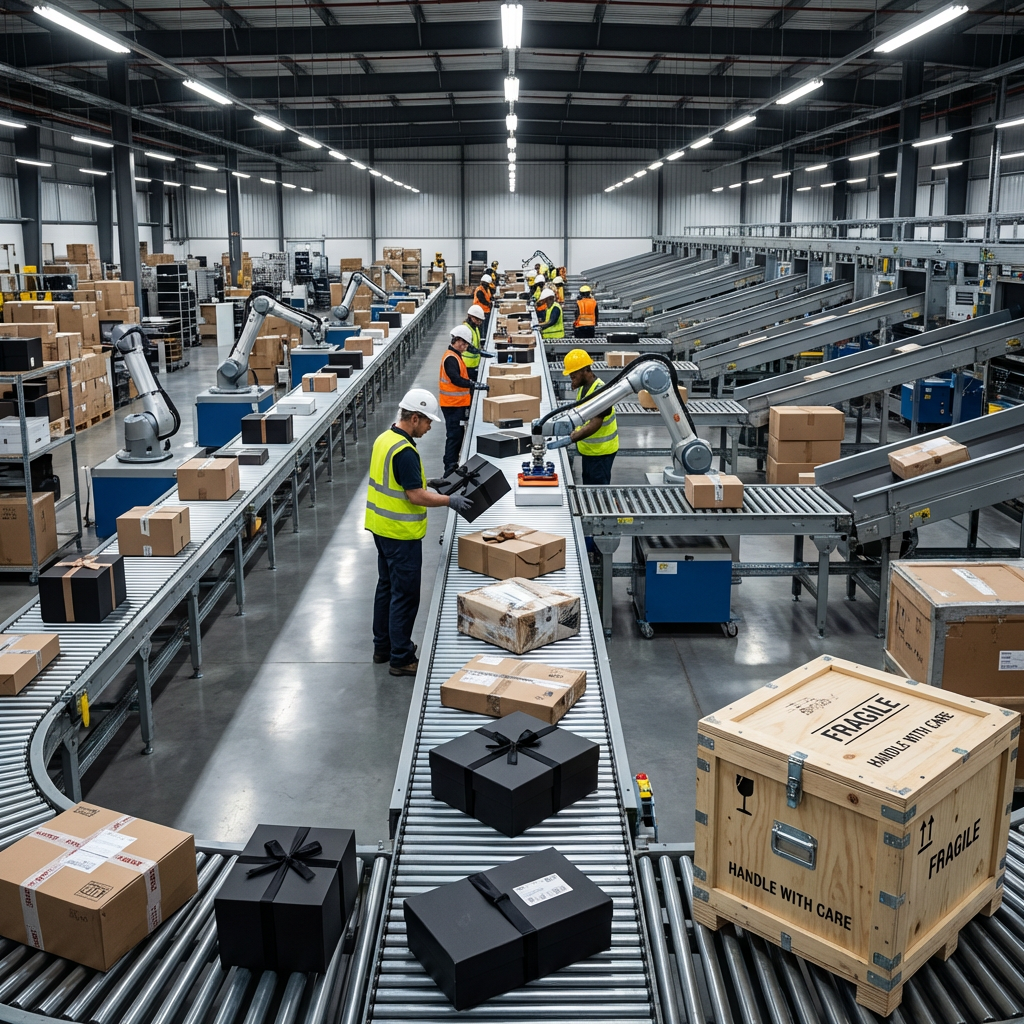
Reverse logistics in luxury resale is not about moving volume
it is about managing variability, value, and risk at scale.
Automation: Where It Works — and Where It Doesn’t
Resale fulfilment is less predictable than traditional retail. This creates tension between the ambition to automate and the variability of inbound flows.
Automation performs best when volume is stable, SKUs are standardised, and processes are repeatable. Secondhand luxury challenges each of these assumptions.
That said, selective automation — in sortation, secure storage systems, and outbound packing — can create measurable gains when designed around operational realities rather than technology trends.
The relevant question is not how much automation to implement.
It is where automation genuinely strengthens flexibility, control, and margin.
Luxury Brands Entering the Circular Model
Luxury houses are no longer observers of resale. Many are launching certified pre-owned programs, partnering with established platforms, or introducing buy-back initiatives.
The rationale is clear:
Protect brand equity
Maintain pricing discipline
Extend product lifecycle
Engage younger consumers
However, integrating resale means building capabilities that historically sat outside the luxury operating model — reverse logistics, refurbishment processes, grading frameworks, and dynamic inventory handling.
Brand strategy and supply chain design are now directly connected.
A Strategic Inflection Point
High-end secondhand is not a temporary phenomenon. It is structural.
For executive teams, the decisions are strategic:
Should resale capabilities be outsourced or vertically integrated?
Where should authentication sit within the value chain?
How can brand integrity be maintained while scaling circularity?
What fulfilment model balances flexibility with cost discipline?
These are not marketing considerations.
They are operating model decisions.
The Future of Circular Luxury
Luxury’s next phase is increasingly:
Circular
Data-informed
Cross-border
Operationally demanding
Brand strength remains critical. But execution capability will increasingly determine who captures value in resale.
In secondhand luxury, the product already carries a story.
The challenge — and the opportunity — lies in designing the supply chain that allows that story to continue, profitably and at scale.
Circular luxury requires operational clarity. Not ambition alone — but structure, discipline, and independent thinking grounded in real-world execution.
Ethon Advisory
Independent minds for complex decisions.